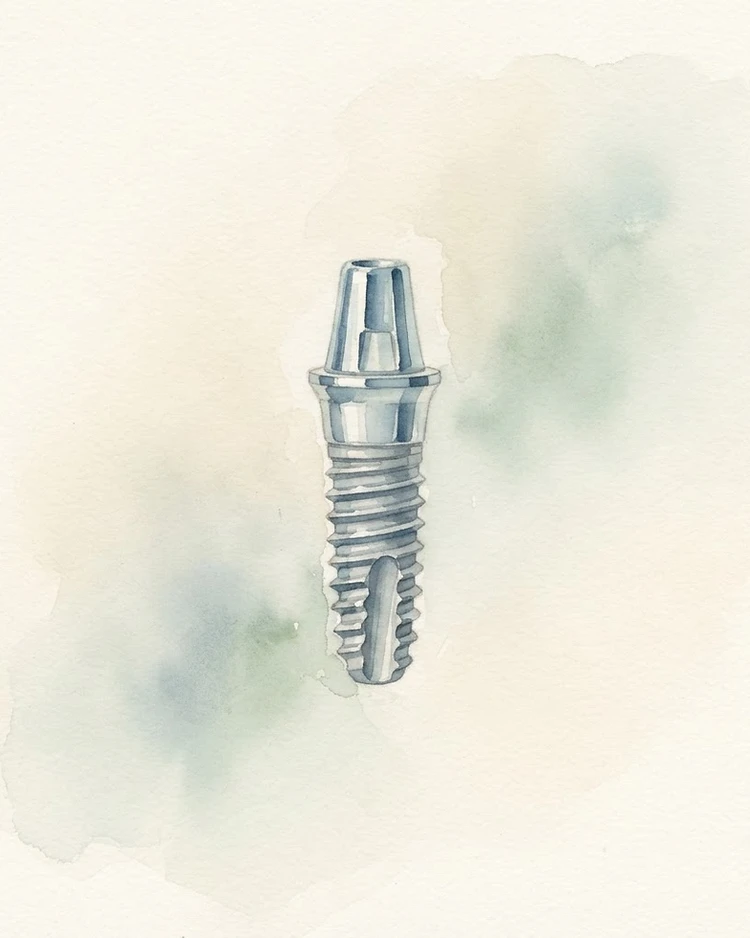
Your path
Your path to fixed teeth
Step by step to your new smile
The path to fixed teeth begins with a personal consultation. After a thorough examination we create an individual treatment plan and discuss all options together. The precise planning of your treatment then follows.
Depending on your starting situation, non-preservable teeth can be removed, implants placed and a temporary restoration fitted. After the healing phase the final dental restoration is fabricated. Throughout the entire process we accompany you personally and are available at any time for questions about your fixed teeth.
01Consultation, advice & diagnostics
1–2 appointmentsA personal conversation, clinical examination, photos and 3D scans (CBCT) form the basis for your individual treatment plan with transparent costs.

02Preparatory measures
Based on the planning, the guided surgical template and the prefabricated immediate restoration are precisely fabricated. For rehabilitation of the edentulous upper jaw, implant-supported concepts are considered the reliable standard according to current consensus [1].
03Surgery
approx. 2–2.5 hoursThe implants are gently placed through the template – under local anaesthesia or sedation. If required, bone grafting (augmentation, sinus lift) is performed in the same procedure.

04Immediate fitting
on the day of surgeryIf primary stability allows, the prefabricated immediate restoration is screwed in immediately – you leave the practice on the same day with fixed teeth.
05Follow-up check
approx. 1–2 weeksFirst check of wound healing, fit and loadability of the immediate restoration, plus oral hygiene briefing.
06Definitive restoration
3–4 months after surgeryAfter healing (osseointegration), a digital scan is taken and the definitive, fixed restoration is fabricated and fitted. Digital workflows increase patient satisfaction and quality of life compared with conventional procedures [2]; the base material also influences retention and quality of life [3].
Risks & compliance
This is how you prepare – and secure success.
Fixed teeth last for decades when preparation and aftercare are right. This checklist helps you safely accompany the procedure and the healing phase.
Pre-operative preparation
- CBCT scan and clinical preliminary examination completed
- Complete medication list provided (anticoagulants, bisphosphonates)
- Blood sugar and blood pressure checked and adjusted
- Informed consent for the individual procedure carried out
- Acute inflammations (e.g. periodontitis) treated in advance
- Smoking cessation ideally already before implantation
Post-operative risks & behavioural rules
- Swelling and mild pain in the first days are normal
- Apply cooling compresses as instructed
- Soft diet in the first week, no hard foods for 8 weeks
- No smoking during the healing phase (osseointegration)
- Gentle oral hygiene – clean the wound area carefully
- Wear the bruxism splint consistently to avoid overload
- Contact the practice immediately if fever or persistent complaints occur
Long-term compliance
- Daily interdental implant cleaning
- Prophylaxis recall every 4–6 months
- Permanent smoking cessation – nicotine lowers the survival rate
- Use the bruxism splint long-term
- Regular bite and X-ray check-ups
- No excessive chewing forces (e.g. ice, hard nuts)
This checklist serves patient education and does not replace individual dental or medical advice. Your practitioner adds the points that are relevant to your personal situation.
Preparation
Preliminary findings – checklist for the findings discussion
This checklist contains what to prepare for the findings discussion: a current CBCT scan, existing dentures or metal frameworks, your medical history and medication plan, and any existing implant passports. Download the PDF as soon as you are interested in fixed teeth or plan a consultation appointment, and bring the documents with you.
- CBCT scan – no older than 2 monthsCurrent three-dimensional X-ray imaging of the jaw for safe implant planning.
- Existing full denture or metal framework?Bring existing removable or metal-supported restorations to the findings discussion.
- Medical history & medication list (standard dentistry)Complete medical history and current medication list for risk assessment.
- Existing implant?If yes: have the implant passport and previous reports ready so existing restorations can be assessed.
Matching the preparation
Medical history & findings sheet
Complete medical and dental history to dental standard – to fill in, print and bring to your appointment.
Knowledge
What are fixed teeth?
Fixed teeth mean quality of life: biting firmly again, eating without worry, enjoying sitting at the table – without a denture that wobbles or rubs. Often this is possible in a single day. Here you can read the evidence on how implants work, what "fixed teeth in a day" means and what requirements must be met.
Knowledge base
Evidence
Sources & scientific literature
- 1.[1] Brånemark PI, Zarb GA, Albrektsson T (Hrsg.). Tissue-Integrated Prostheses: Osseointegration in Clinical Dentistry. Chicago: Quintessence; 1985.
- 2.[2] Albrektsson T, Zarb G, Worthington P, Eriksson AR. The long-term efficacy of currently used dental implants: a review and proposed criteria of success. Int J Oral Maxillofac Implants. 1986;1(1):11-25.
- 3.[3] Adell R, Lekholm U, Rockler B, Brånemark PI. A 15-year study of osseointegrated implants in the treatment of the edentulous jaw. Int J Oral Surg. 1981;10(6):387-416.
- 4.[4] Buser D, Sennerby L, De Bruyn H. Modern implant dentistry based on osseointegration: 50 years of progress, current trends and open questions. Periodontol 2000. 2017;73(1):7-21.
- 5.[5] Maló P, Rangert B, Nobre M. „All-on-4" immediate-function concept with Brånemark System implants for completely edentulous mandibles: a retrospective clinical study. Clin Implant Dent Relat Res. 2003;5(Suppl 1):2-9.
- 6.[6] Esposito MA, Koukoulopoulou A, Coulthard P, Worthington HV. Interventions for replacing missing teeth: dental implants in fresh extraction sockets (immediate, immediate-delayed and delayed implants). Cochrane Database Syst Rev. 2006;(4):CD005968.
- 7.[7] Jensen OT, Shulman LB, Block MS, Iacono VJ. Report of the Sinus Consensus Conference of 1996. Int J Oral Maxillofac Implants. 1998;13(Suppl):11-45.
- 8.[8] Chiapasco M, Zaniboni M, Boisco M. Augmentation procedures for the rehabilitation of deficient edentulous ridges with oral implants. Clin Oral Implants Res. 2006;17(Suppl 2):136-159.
- 9.[9] Ruggiero SL, Dodson TB, Fantasia J, et al. American Association of Oral and Maxillofacial Surgeons position paper on medication-related osteonecrosis of the jaw—2014 update. J Oral Maxillofac Surg. 2014;72(10):1938-1956.
- 10.[10] Khosla S, Burr D, Cauley J, et al. Bisphosphonate-associated osteonecrosis of the jaw: report of a task force of the American Society for Bone and Mineral Research. J Bone Miner Res. 2007;22(10):1479-1491.
- 11.[11] Madrid C, Sanz M. What influence do anticoagulants have on oral implant therapy? A systematic review. Clin Oral Implants Res. 2009;20(Suppl 4):96-106.
- 12.[12] Strietzel FP, Reichart PA, Kale A, et al. Smoking interferes with the prognosis of dental implants: a systematic review and meta-analysis. J Clin Periodontol. 2007;34(6):523-544.
This overview serves patient information and does not replace individual dental or medical advice. The cited sources are original scientific papers and systematic reviews.
Sources
Scientific sources
| # | Title | Year | Link |
|---|---|---|---|
| 1. | Consensus Report: Rehabilitation of the Edentulous Maxilla (1st Global Consensus) | 2026 | PubMedPMID: 41732051 |
| 2. | Satisfaction and Quality of Life with Digital vs. Conventional Complete Dentures — A Systematic Review and Meta-Analysis | 2025 | PubMedPMID: 41295945 |
| 3. | Retention and OHRQoL — Heat-Cured vs. 3D-Printed vs. Polyamide Denture Bases | 2026 | PubMedPMID: 41744932 |
The cited works come from peer-reviewed specialist journals and provide scientific evidence for the content presented; they do not replace individual dental advice.
Still questions about the process?
Get to know our team and our treatment philosophy – so you can take the first step with confidence.