When retention fades
Denture won't hold?
When a full denture wobbles, rubs or no longer holds securely in the mouth, it is not a personal failure but a well-known anatomical and medical reality. Here you can understand why dentures lose their hold in the upper and lower jaw – and when fixed teeth are the better solution.
Why full dentures lose their hold at all
A full denture holds essentially through negative pressure (suction) and adhesion between the denture base and the mucosa – in the upper jaw additionally through palatal suction. This mechanism depends on fit, saliva volume, mucosa condition and the shape of the jaw ridge [1,2].
When one of these factors changes – usually through the gradual resorption of the jaw ridge after tooth loss – the denture continuously loses its hold. Denture adhesive and relines ease the symptom but do not stop the cause: bone loss [1].
Why the full denture does not hold in the upper jaw
In the upper jaw, retention comes mainly from suction over the hard palate. When the bearing surface shrinks or mucosa and saliva change, this suction breaks – the denture loosens while speaking, laughing or eating.
- Bone resorption (atrophy): After tooth loss the upper jaw ridge diminishes in height and width year after year. The bearing surface shrinks, the suction breaks – the denture loses its hold [1,2].
- A flat or severely resorbed jaw ridge offers no retention surface on which the denture could suction.
- Mobile or soft palatal mucosa and a high palate reduce the palatal suction that is decisive for retention.
- Too little saliva (xerostomia, often medication-induced) deprives the denture of adhesion; too much saliva breaks the suction straight away.
Why the full denture does not hold in the lower jaw
The lower jaw is considered the most difficult restoration for a full denture: it lacks the large palatal surface that could generate suction. Retention depends almost entirely on ridge shape, muscle guidance and the denture border – and these are highly mobile.
- In the lower jaw the large palatal surface is missing – a full denture here holds almost only through ridge shape, muscle guidance and the denture border, which is considerably more prone to failure.
- The highly mobile soft-tissue envelope of tongue, cheeks and lips shifts the denture with every facial movement and every chew.
- A resorbed, flat lower jaw ridge offers no anatomical guidance – the denture "floats" [1].
- High chewing forces and constant tongue activity create leverage that further destabilises the already limited hold.
General causes for declining denture fit
- Ongoing jaw bone loss over the years – the most common reason for declining denture fit [1,2]
- Material fatigue and warped denture base: the fit is lost
- Weight fluctuations change the mucosa and ridge shape
- Previous periodontitis with bone loss – the foundation was already reduced before the denture
- Outdated relines instead of a new fabrication
- Material and base resin influence retention and quality of life: 3D-printed and polyamide bases sometimes achieve different retention and OHRQoL values than classic heat-cured bases [6]
When the denture no longer holds – the path to fixed teeth
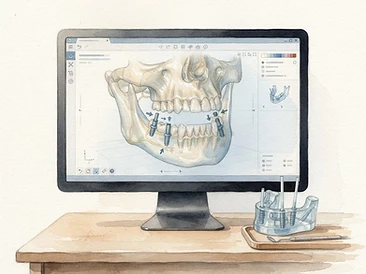
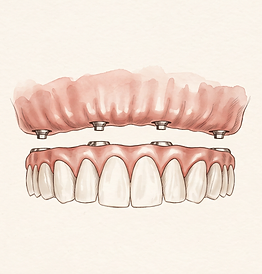
Relines and denture adhesives only ease the problem symptomatically – they do not stop the bone loss that is the actual cause of the declining hold [1]. An implant-supported restoration breaks this vicious circle: implants preserve the jaw bone, replace the unreliable suction with mechanical anchoring and provide fixed teeth that do not slip.
A current systematic review shows that fixed, implant-supported restorations perform functionally and clinically better than removable full dentures in edentulous patients [3].
Whether through single implants, an implant-supported bridge or an All-on-X concept (4 or 6 implants per jaw): fixed teeth restore the security that a full denture cannot provide in the long term.


More than comfort: nutrition, health and breathing
A wobbling full denture affects not only retention but overall health. Meta-analyses show that implant-supported restorations markedly improve food intake and nutritional status of older edentulous patients compared with full dentures [4,7].
Breathing can also be affected: in patients with obstructive sleep apnoea a full denture can additionally impair the airways during sleep [5]. An implant-supported restoration can help reduce this strain and provides firm hold – even at night.
Sources
Sources
- 1.[1] Tallgren A. The continuing reduction of the residual alveolar ridges in complete denture wearers: a mixed-longitudinal study of 1972. J Prosthet Dent. 1972;27(2):120-132.
- 2.[2] Atwood DA. Reduction of residual ridges: a major oral disease entity. J Prosthet Dent. 1971;26(3):266-279.
- 3.[3] Choosing Between Fixed and Removable Prosthetic Modalities for Completely Edentulous Patients — Systematic Review. Cureus, 2026. PMID: 41669595.
- 4.[4] Nutritional Outcomes of Overdentures vs. Complete Dentures in Older Edentulous Adults — Systematic Review & Meta-Analysis. J Oral Rehabil, 2026. PMID: 41399921.
- 5.[5] Respiratory Impact of Complete Dentures in Patients with Obstructive Sleep Apnea — RCT. J Prosthet Dent, 2025. PMID: 40645864.
- 6.[6] Retention and OHRQoL — Heat-Cured vs. 3D-Printed vs. Polyamide Denture Bases. Int J Dent, 2026. PMID: 41744932.
- 7.[7] Effect of Prosthodontic Rehabilitation on Nutrition and Health in Edentulous Elderly — Systematic Review. Int J Dent, 2026. PMID: 41696624.
Review your options for fixed teeth
Get to know the treatment workflow and take the first step with confidence.